
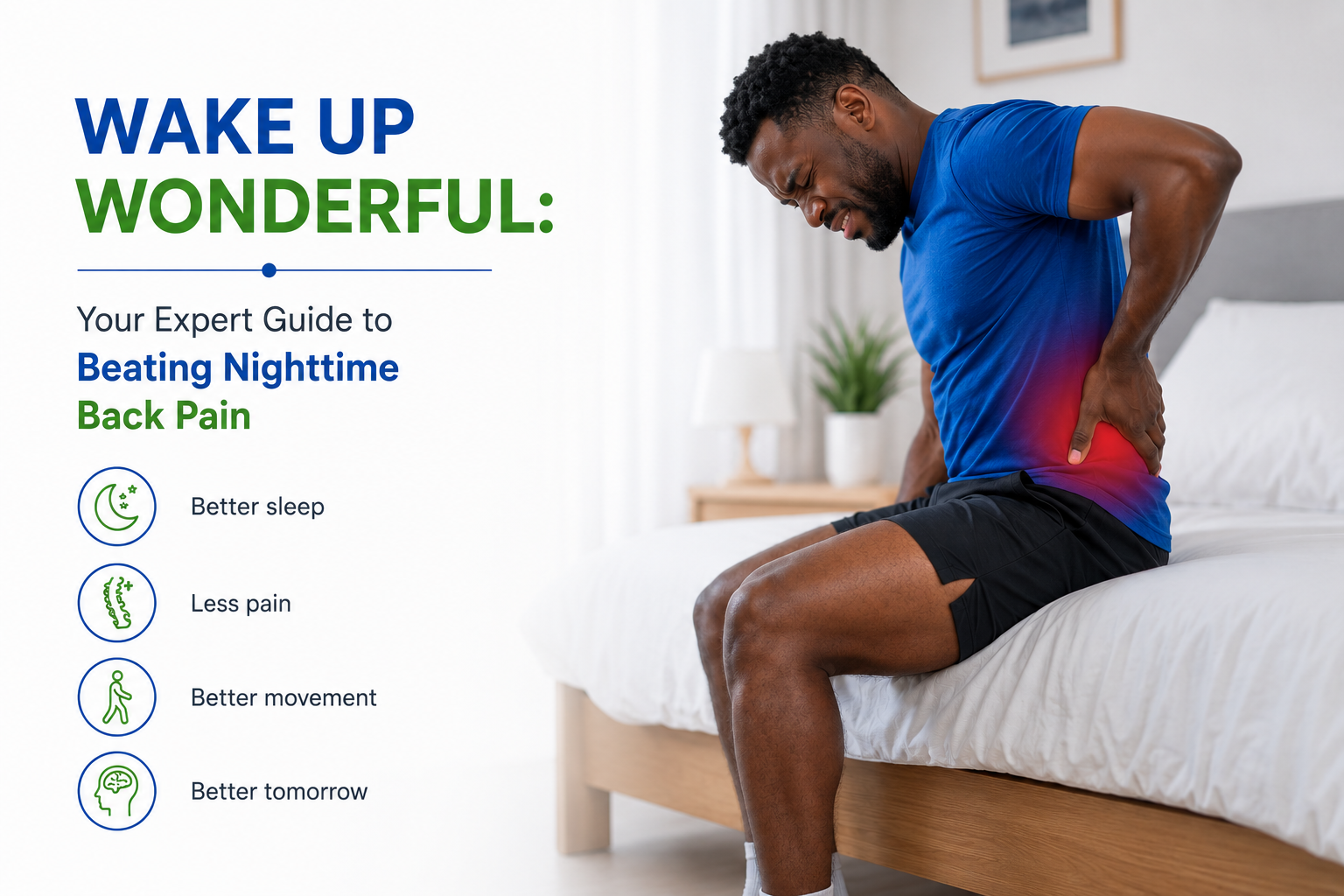
Wake Up Wonderful: Your Expert Guide to Beating Nighttime Back Pain
Do you dread going to bed, knowing that back pain will be your unwelcome companion through the night? You’re not alone.
Many people experience back pain that intensifies in the evening or during sleep, only to feel relatively better once they are up and moving during the day.
This is common yet frustrating phenomenon can significantly impact your quality of life and sleep.
As an orthopedic physiotherapist i understand the nuances of this discomfort and am here to shed light on why it happens and more importantly, how you can find lasting relief.
The Nighttime Back Pain Enigma: Why It Hurts More When You Rest
It might seem counter-intuitive that your back pain worsens when you’re at rest, especially after a day of activity.
However, several factors contribute to this nocturnal discomfort:
- Sustained Posture and Spinal Loading: During the day, your movements constantly shift the load on your spine. At night, maintaining a single sleeping position for hours can place continuous, static stress on specific spinal structures, joints, and muscles. This prolonged, unchanging pressure can exacerbate underlying issues.
- Inflammatory Processes: Daily activities, even seemingly minor ones, can lead to micro-traumas and an accumulation of inflammatory chemicals in your tissues. While movement and activity during the day can help to circulate these chemicals and mask pain, lying still at night allows them to settle, increasing pain perception.
- Reduced Muscle Support: As you drift into deeper sleep, your muscles relax. If your core muscles are weak or imbalanced, this relaxation can lead to decreased spinal support, allowing for greater strain on ligaments and discs. This is particularly relevant if you have pre-existing conditions.
- Poor Sleep Ergonomics: Your mattress, pillows, and sleeping position play a critical role. An unsupportive mattress or an awkward sleeping posture can misalign your spine, compress nerves, or strain soft tissues, leading to pain that becomes more pronounced as the night progresses.
Pin-pointing Your Pain: Common Areas of Night-time Back Discomfort
Nighttime back pain can manifest in various ways, with the location often providing clues about its potential cause:
- Pain Along the Side of the Back While Sleeping: If you primarily sleep on your side, pain in this region can often be attributed to improper spinal alignment. Without adequate support (e.g., a pillow between your knees), your upper leg can pull your pelvis and spine out of a neutral position, straining the lower back and hip joints. It could also indicate issues with the sacroiliac (the tailbone) joint or trochanteric bursitis (inflammation of the bursa/fluid sac on the outside of your hip).
- Hip Pain at Night: This is a common complaint, especially for side sleepers. Conditions like hip bursitis, osteoarthritis of the hip, or even referred pain from the lower back can cause significant discomfort, making it difficult to find a comfortable position.
- Tailbone Pain (Coccydynia): Discomfort around the tailbone can be severely aggravated by sitting or lying on your back. This pain can result from direct trauma, repetitive strain, or even poor posture that places undue pressure on the coccyx. It often feels like a sharp, localized ache.
- Pain Radiating Down the Leg (Sciatica): This distinctive symptom, characterized by a sharp, shooting pain, numbness, or tingling that travels from the lower back, through the buttock, and down the leg, is a hallmark of sciatic nerve irritation or compression. Conditions like a herniated disc, spinal stenosis, or piriformis syndrome can cause sciatica, which frequently worsens at night due to sustained pressure on the nerve roots or inflammatory processes.
Your Blueprint for Blissful Sleep: An Orthopedic Physiotherapist’s Strategies
Reclaiming your nights from back pain is achievable with a targeted approach. Here’s how you can proactively address and alleviate your nocturnal discomfort:
1. Optimize Your Sleep Environment
-
Mattress Assessment: Your mattress should provide a balance of support and comfort, maintaining the natural curves of your spine. If your mattress is older than 7-10 years, sags, or feels unsupportive, it might be contributing to your pain. A medium-firm mattress is often recommended for general back health
-
Pillow Placement: Strategic pillow use can significantly improve spinal alignment
-Side Sleepers: Place a firm pillow between your knees to keep your hips, pelvis, and spine aligned. Ensure your head pillow supports your neck in a neutral position.
-Back Sleepers: A small pillow or rolled towel under your knees can help maintain the natural curve of your lower back and reduce strain. Your head pillow should support the natural curve of your neck.
-
Avoid Stomach Sleeping: This position often forces your neck into an unnatural twist and can flatten the natural curve of your lower back, increasing strain and potentially worsening pain
2. Embrace Movement and Stretching
- Pre-Sleep Routine: Incorporate gentle stretches before bed to relax tight muscles and improve flexibility. Consider exercises like knee-to-chest stretches, pelvic tilts, and gentle spinal twists. Avoid vigorous exercise close to bedtime.
- Daytime Activity: Regular movement throughout the day is crucial. If your job involves prolonged sitting, take frequent breaks to stand, walk, and stretch. Integrate ergonomic principles into your workstation to minimize spinal stress.
3. Strengthen Your Core and Glutes
- A strong core and well-conditioned gluteal muscles provide essential stability and support for your spine. Incorporate exercises such as planks, bird-dog, and glute bridges into your routine. A physiotherapist can design a personalized program to strengthen these vital muscle groups effectively.
4. Manage Inflammation and Pain
- Cold or Heat Therapy: Applying a cold pack to an acutely painful or inflamed area for 15-20 minutes before bed can help reduce inflammation. For chronic stiffness, a warm bath or heat pack might offer relief.
- Over-the-Counter Relief: Non-steroidal anti-inflammatory drugs (NSAIDs) can help manage pain and inflammation, but always consult a healthcare professional before starting any new medication.
When to Seek Professional Guidance: Your Physiotherapy Journey
While self-management strategies can be highly effective, persistent or worsening nighttime back pain, especially if accompanied by new numbness, weakness, or radiating pain down the leg (sciatica), warrants a professional evaluation.
An orthopedic physiotherapist is uniquely qualified to:
-
Conduct a Comprehensive Assessment: Identify the precise cause of your pain through a detailed physical examination and movement analysis.
-
Develop a Personalized Treatment Plan: This may include manual therapy techniques (such as joint mobilization and soft tissue release), therapeutic exercises, and modalities to reduce pain and restore function.
-
Provide Ergonomic and Lifestyle Advice: Offer tailored recommendations for your sleep environment, daily activities, and workstation to prevent recurrence.
-
Educate and Empower: Equip you with the knowledge and tools to manage your condition long-term and maintain a healthy, pain-free back. Don’t let nighttime back pain dictate your sleep or your life.
By understanding the causes and implementing evidence-based strategies, you can take significant steps towards waking up refreshed and pain-free. Consult with an orthopedic physiotherapist to embark on your personalized path to relief.
Author
Moses Katasi - Orthopedic Physiotherapist Book an appointment
BSc, Dip, Post-graduate Diploma in Orthopedic Physiotherapy - AMREF International University, Certified Clinical Physiotherapy Instructor (CPTI) Kenya, Optimal Dry Needling Specialist (ODNS) at International Academy of Orthopedic Medicine(IAOM) - USA.
Disclaimer:
This blog post is for informational purposes only and does not constitute medical advice. Always consult with a qualified orthopedic physiotherapist or healthcare professional for diagnosis and treatment of any medical condition.
References
[[1] Mayo Clinic. (n.d. ). Back pain - Diagnosis and treatment.](https://www.mayoclinic.org/diseases-conditions/back-pain/diagnosis-treatment/drc-20369911)
[[2] Chou, R., & Huffman, L. H. (2007 ). Nonpharmacologic therapies for acute and chronic low back pain: a review of the evidence for an American Pain Society/American College of Physicians clinical practice guideline. Annals of Internal Medicine, 147(7), 492-504.](https://www.acpjournals.org/doi/abs/10.7326/0003-4819-147-7-200710020-00007)
[[3] George, S. Z., et al. (2021 ). Interventions for the Management of Acute and Chronic Low Back Pain: Revision 2021. Journal of Orthopaedic & Sports Physical Therapy, 51(11), CPG1-CPG60.](https://www.jospt.org/doi/10.2519/jospt.2021.0304)
[[4] Mayo Clinic. (2024 ). Sleeping positions that reduce back pain.](https://www.mayoclinic.org/diseases-conditions/back-pain/in-depth/sleeping-positions/art-20546852)
[[5] Cleveland Clinic. (n.d. ). Sciatica: What It Is, Causes, Symptoms, Treatment & Pain Relief.](https://my.clevelandclinic.org/health/diseases/12792-sciatica)
[[6] Hospital for Special Surgery. (n.d. ). Sciatica: Simple Symptoms, Complex Causes.](https://www.hss.edu/health-library/conditions-and-treatments/list/sciatica)
[[7] National Institute of Neurological Disorders and Stroke. (n.d. ). Back Pain Fact Sheet.](https://www.ninds.nih.gov/Disorders/Patient-Caregiver-Education/Fact-Sheets/Back-Pain-Fact-Sheet)
[[8] Davis, D., et al. (2024 ). Sciatica. StatPearls.](https://www.ncbi.nlm.nih.gov/books/NBK507908/)
[[9] Healthdirect Australia. (2025 ). Sciatica - treatment, symptoms and causes. ](https://www.healthdirect.gov.au/sciatica)
[[10] Harvard Health Publishing. (n.d. ). Stretching: 8 best stretches for back pain relief. Retrieved from](https://www.health.harvard.edu/pain/stretching-8-best-stretches-for-back-pain-relief)
[[11] Hospital for Special Surgery. (n.d. ). Physical Therapy for Lower Back Pain.](https://www.hss.edu/health-library/move-better/physical-therapy-for-lower-back-pain)[(n.d. ). Back pain - Self-care.](https://www.mayoclinic.org/diseases-conditions/back-pain/self-care)
[[13] American College of Physicians. (n.d. ). American College of Physicians issues guideline for treating nonradicular low back pain.](https://www.acponline.org/acp-newsroom/american-college-of-physicians-issues-guideline-for-treating-nonradicular-low-back-pain)
[[14] Shipton, E. A. (2018 ). Physical Therapy Approaches in the Treatment of Low Back Pain. Anesthesiology and Pain Medicine, 8(6).](https://pmc.ncbi.nlm.nih.gov/articles/PMC6251828/)