
Why Does My Lower Back Hurt More When I Move? A Physiotherapist’s Guide
Have you ever noticed that your lower back feels okay when you’re resting, but the moment you bend over to tie your shoes, twist to grab something, or lean back, a sharp pain stops you in your tracks?
If your lower back pain gets worse with movement, you are definitely not alone. As an orthopedic physiotherapist, I hear this exact complaint every single day. It’s incredibly frustrating when simple, everyday movements suddenly become painful hurdles.
But here is the good news: pain that changes with movement is actually a good sign. It means your pain is mechanical, which means it can usually be fixed with the right approach.
Let’s break down exactly why your back hurts when you move, what might be causing it, and what you can do to get back to moving freely without all the confusing medical jargon.
Why Movement Triggers Lower Back Pain
Think of your lower back as a complex system of hinges, shock absorbers, and support cables. When everything is working smoothly, you can bend, twist, and lift without a second thought.
But when one part of this system is irritated, tired, or strained, movement puts pressure right on that sensitive spot. When you move, your muscles have to contract, your joints have to slide, and your spinal discs have to compress and stretch.
If there is inflammation or a minor injury in any of these areas, the physical act of moving acts like pressing a bruise. The pain is your body’s alarm system saying, “Hey, be careful with that spot right now!”
Common Causes of Back Pain That Worsens With Movement
If we look at the way you move when the pain hits, it gives us huge clues about what is going on. Here are the most common culprits:
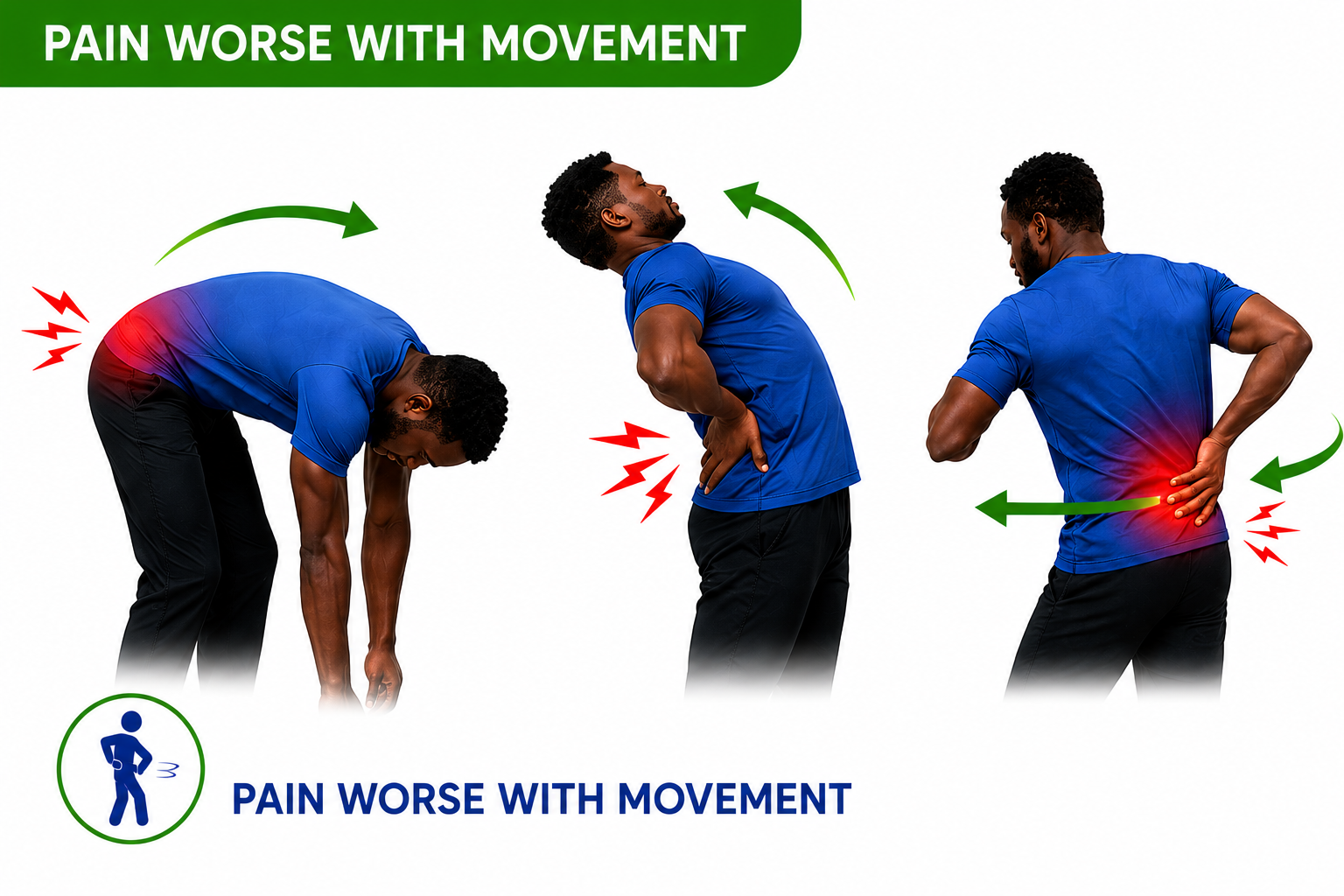
The “Bending Forward” Pain (Muscle Strains and Discs
If leaning forward (like touching your toes or picking something up off the floor) triggers your pain, it usually points to one of two things:
-
Tired or Strained Muscles: The muscles in your lower back work like bungee cords to keep you from falling forward.
If you’ve been lifting heavy things, sitting in a slouched position for hours, or doing a new workout, these muscles can get overworked and strained.
When you bend forward, you stretch those already irritated “bungee cords,” causing pain.
-
Irritated Shock Absorbers (Discs): Between the bones in your spine are squishy pads that act as shock absorbers.
Bending forward puts extra pressure on the front of these pads, which can push the squishy center backward.
If the pad is already a bit irritated, this forward-bending motion can cause a sharp, pinching pain.
The “Leaning Backward” Pain (Joint Irritation)
If arching your back, reaching up high, or standing up straight after sitting for a long time causes a pinch in your lower back, the issue is usually in the joints.
-
Jamming the Hinges: The back of your spine has small hinges (called facet joints) that guide your movement.
When you lean backward, these hinges compress together. If they are stiff from lack of movement, or irritated from poor posture, leaning back jams them together, creating a sharp, localized pain.
The “Twisting” Pain (Ligament or Muscle Sprains)
Does it hurt when you turn to look over your shoulder or swing a golf club?
-
Overstretched Support Cables: Your spine is wrapped in strong bands of tissue (ligaments) that keep it stable.
Twisting motions, especially sudden ones or twisting while lifting something heavy, can overstretch these bands or the smaller diagonal muscles in your back.
Why You Shouldn’t Just “Rest It Out”
When movement hurts, your first instinct is probably to stop moving entirely. You might want to lay on the couch for a few days and wait for it to pass.
While a day of rest is fine for a severe flare-up, staying completely still is actually one of the worst things you can do for lower back pain.
Here is why: your spine needs movement to heal. Movement brings fresh blood flow, oxygen, and nutrients to the injured area.
It also prevents your muscles and joints from stiffening up. If you stop moving, your back gets stiff, your muscles get weak, and the pain often gets worse when you finally do try to move again.
What You Can Do Right Now
If you are dealing with lower back pain that spikes when you move, here is a simple game plan to start feeling better:
-
Find Your “Safe” Movements: Pay attention to what movements feel okay. If bending forward hurts, try keeping your back straight and bending at your hips and knees instead.
Find the postures that give you relief and use them throughout the day.
-
Keep Moving, But Gently: Don’t push through sharp, stabbing pain, but do try to keep moving in ways that feel safe. Gentle walking is often one of the best medicines for lower back pain.
-
Use Heat or Ice: If your back feels tight and stiff, a heating pad can help relax the muscles. If you recently tweaked it and it feels hot or throbbing, an ice pack might feel better. Use whichever gives you the most relief.
-
Change Positions Often: Your spine hates staying in one position for too long. If you sit at a desk, stand up and walk around for a minute every half hour. If you stand all day, find a stool to prop one foot on to change the angle of your back.
When to See a Physiotherapist
While most lower back pain clears up on its own with gentle movement and time, you shouldn’t have to suffer through it alone.
You should definitely reach out to a physiotherapist if:
-
The pain is severe and not getting better after a few days.
-
You feel pain, numbness, or tingling shooting down your leg.
-
The pain is stopping you from sleeping or doing your normal daily activities. As a physiotherapist, my job isn’t just to treat the pain, it’s to figure out why that specific movement hurts and give you the exact tools and exercises to fix it.
We can help you get your spine moving smoothly again so you can get back to doing what you love, pain-free.
Author
Moses Katasi - Orthopedic Physiotherapist Book an appointment
BSc, Dip, Post-graduate Diploma in Orthopedic Physiotherapy - AMREF International University, Certified Clinical Physiotherapy Instructor (CPTI) Kenya, Optimal Dry Needling Specialist (ODNS) at International Academy of Orthopedic Medicine(IAOM) - USA.
Disclaimer:
This blog post is for informational purposes only and does not constitute medical advice. Always consult with a qualified orthopedic physiotherapist or healthcare professional for diagnosis and treatment of any medical condition.