That Hip Pain You’re Ignoring: Could Be Weak Glutes Causing Your Limp?
If you’ve been dealing with hip pain, knee discomfort, or even stubborn low back pain, you might be focusing on the wrong area.
As an orthopedic physiotherapist, one of the most overlooked causes I see is weakness of the gluteus medius muscle, a key stabilizer of your hip. When this muscle isn’t doing its job, it can lead to a walking limping pattern called Trendelenburg gait, which quietly places stress on your hip, knee, and lower back over time.
What Is The Gluteus Medius & Why Does It Matter?
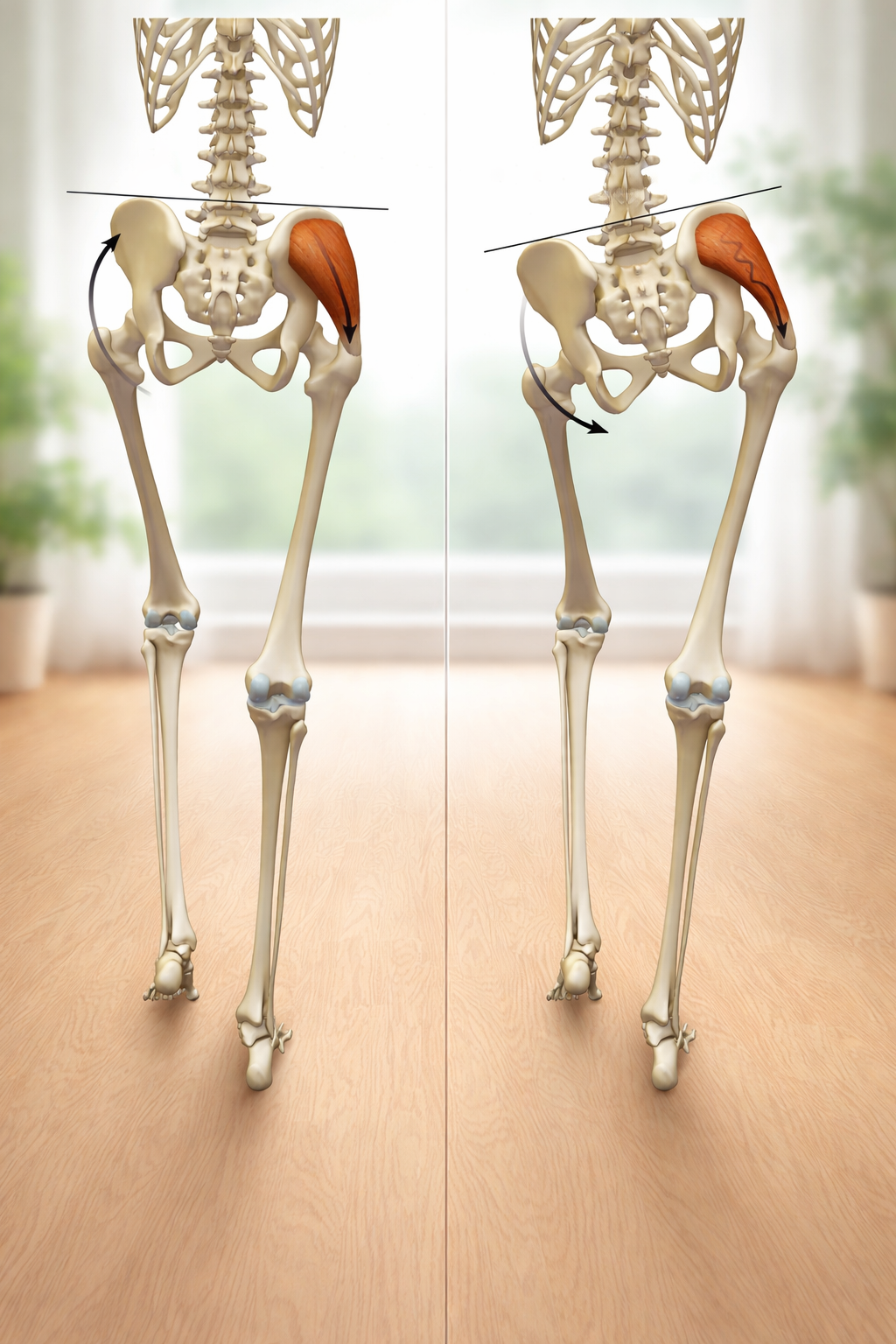
The gluteus medius is a muscle located on the side of your hip, the buttocks muscles. Its main job is simple but critical it is responsible with keeping your pelvis level when you stand or walk, stabilizes your hip during movement and prevents your body from dropping on one side.
Every time you take a step, this muscle works to keep you balanced. If it’s weak, your body starts compensating and that’s where problems begin.
What Is Trendelenburg Gait?
When the gluteus medius is weak, your body can’t stabilize properly during walking instead your pelvis drops on one side, upper body leans to the opposite side and then you develop a noticeable limp or sway on one side when walking referred as Trendelenburg gait.
You may not even notice it at first but your joints definitely feel it.
How This Leads To Hip Pain
When your hip isn’t stable the joint takes uneven pressure, muscles around the hip overwork to compensate, it’s tendons become much irritated resulting in outer hip pain, deep aching pain in the hip joint and pain when walking or standing for long.
Many people think this is “just aging” or “normal pain” but it’s often a muscle control issue.
How Your Knee Start Hurting Too
A weak gluteus medius affects how your entire leg moves which leads to poor alignment of the thigh and knee, increased stress on the knee joint and also strains ligaments and cartilage in the process.
These are common symptoms related;
- Knee pain when walking or climbing stairs.
- Pain around the kneecap.
- Feeling of instability.
As an orthopedic physiotherapist in this type of knee pain, however much the knee is treated it doesn’t get better if its treated alone, because the root problem is higher up in the hip.
The Link To Low Back Pain
If your pelvis is unstable, your lower back tries to compensate in the process and overtime causes tightness in the lower back, muscle fatigue and its persistence results to chronic back pain.
So if you’ve been treating back pain without success, your hip strength may be the missing piece and that’s the reason why you need to see us.
Signs Your Gluteus Medius Is Weak
In general this are signs to suggest that your gluteus medius may be weak, this can be well diagnosed by a physiotherapist.
This signs include;
- Slight limp when walking.
- Hip dropping on one side.
- Pain when standing on one leg.
- Knee pain without a clear injury
- Pain on the back that doesn’t improve.
Can This Be Fixed
Yes, this can be fixed.. absolutely through exercises.
In this case you need specific exercises that activate the gluteus medius not just general workouts and this can only be well done by physiotherapists together with other treatments.
Final Advice
Not all hip or knee pain starts where you feel it.
Sometimes, the real problem is a small muscle on the side of your hip that’s quietly failing to do its job.
If you’re in Nairobi and dealing with hip, knee, or back pain, a proper physiotherapy assessment can identify the root cause not just treat the symptoms BUT the problem.
Author
Moses Katasi - Orthopedic Physiotherapist Book an appointment
BSc, Dip, Post-graduate Diploma in Orthopedic Physiotherapy - AMREF International University, Certified Clinical Physiotherapy Instructor (CPTI) Kenya, Optimal Dry Needling Specialist (ODNS) at International Academy of Orthopedic Medicine(IAOM) - USA.