
When One Leg Is Shorter: Why Your Back Might Hurt
Many people with back pain are told they have a “short leg.” While it’s true that some people do have legs that are actually different lengths, what looks like a short leg is often something else entirely.
It might be caused by how you stand, how you move, muscle imbalances, or even your body’s reaction to pain.
From a movement and posture perspective, the real question isn’t just “Is one leg shorter?” but rather “Is this difference actually causing my pain and making it hard for me to move?”
A good assessment helps find the real reason for the problem and guides proper treatment instead of making assumptions. Real healing starts by understanding how your whole body moves, not just measuring one thing.
Understanding Leg Length Differences
A leg length difference simply means one leg is noticeably shorter than the other. But this simple-sounding issue is actually more complicated than it seems. Not every leg length difference matters, and not every difference causes pain.
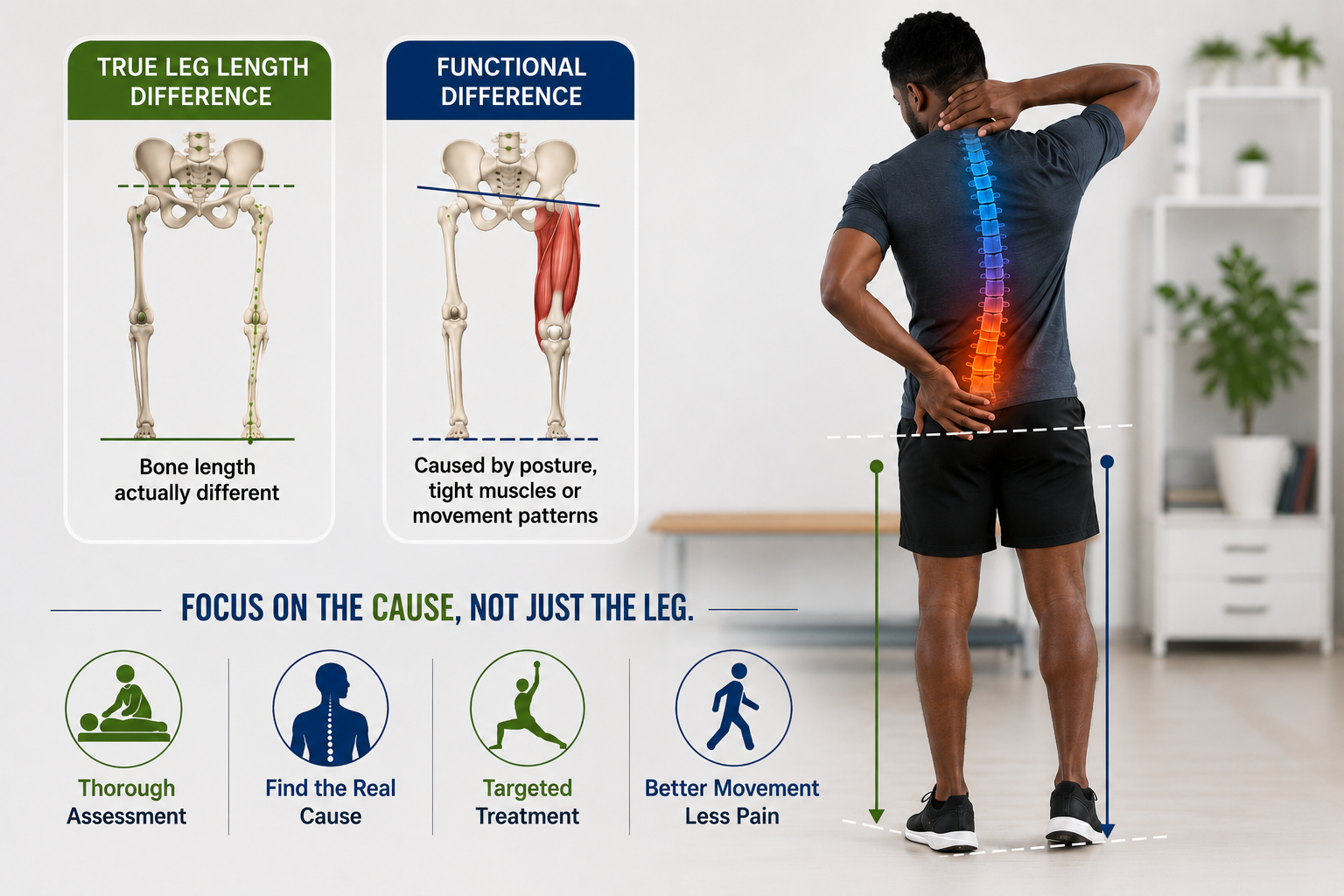
Two Different Types of Leg Length Differences
-
Real structural differences: This is when one leg bone is actually shorter than the other. This can be seen on X-rays and happens because of things like birth differences, injuries, broken bones that healed differently, wear and tear over time, or surgery.
-
Differences that appear but aren’t structural: This is when your legs look different lengths, but the bones are actually the same. Instead, it happens because of how your pelvis sits, tight or weak muscles, stiff joints, how your foot lands when you walk, or curves in your spine.
This difference matters a lot because it changes how you should be treated. Many people who seem to have a short leg actually just have muscle imbalances or posture issues that can be fixed with the right exercises and movement training.
How Many People Have This?
About 9 out of 10 adults have some kind of leg length difference. But just because you have a difference doesn’t mean it’s causing problems or that you need treatment.
Research looking at X-rays of many people found that 9 out of 10 had some difference in bone length, and about 2 out of 10 had a difference bigger than about 1/3 of an inch.
How a Shorter Leg Affects Your Back and Posture
When one leg is shorter whether it’s actually shorter or just appears that way your body has to adjust. Your body is smart and tries to keep your head level and your body balanced. But these adjustments can cause problems throughout your entire body, from your feet all the way up to your head.
Your Pelvis Has to Tilt
Your pelvis naturally tilts to make up for the height difference. The hip bone on the short leg side rotates forward, while the hip bone on the long leg side rotates backward.
This tilting keeps happening even when you’re standing still or walking. Your body does this automatically to try to keep you balanced, but the cost is that stress gets spread unevenly across your spine and muscles
Your Spine Curves Differently
To keep your head upright and your body straight, your spine may develop a curve to one side. This sideways curve is a common way your body adapts to a leg length difference, especially in your lower back.
This uneven curving can change how pressure is distributed on your spine bones and joints. Over time, this uneven pressure can lead to wear and tear and pain.
Your Muscles Work Unevenly
The uneven positioning puts different amounts of stress on your muscles, ligaments, and joints. Muscles on one side of your body have to work harder to keep you balanced and stable.
This causes them to get tired, tight, and eventually painful. Over time, this can create muscle imbalances, weakness, and injuries from overuse. This is why people with a leg length difference often feel tightness on one side or notice their pain gets worse with activity.
Your Walking Pattern Changes
The way you walk changes to adjust for the difference. Your body might lift your center of gravity higher with each step, which uses more energy. You might swing one leg out to the side, walk on your tiptoes, or take different sized steps.
While your body does these things to protect itself at first, over time these walking patterns can cause more problems because they keep putting stress in the wrong places.
The Important Number: 2 Centimeters
Here’s something important: if one leg is shorter by less than about 3/4 of an inch (2 centimeters), your body can usually handle it just fine. Your body can adapt to small differences through small curves in your spine, changes in how your joints angle, and adjustments in your muscle length.
But if the difference is bigger than that, your muscles have to work harder to compensate.This means not every leg length difference needs treatment. The key question is whether the difference is actually causing your pain and making it hard to do things.
How to Know If a Leg Length Difference Is Your Problem
A good assessment goes way beyond just measuring your legs with a tape measure. The goal is to understand how your whole body moves, find out what’s really causing the problem, and figure out whether a leg length difference is actually making your pain worse.
What a Thorough Assessment Includes
- Talking about your pain: Understanding when it started, where it hurts, how bad it is, what activities make it worse, and how it affects your daily life. This background information is really important for figuring out whether a leg length difference is really the problem or just something that happens to be there.
- Looking at how you stand: Watching how your body lines up when you’re standing and sitting, including your hip position, spine curves, shoulder height, and head position. A trained professional looks for patterns that show your body is working harder on one side than the other.
- Watching how you walk: Observing your walking pattern, step length, walking speed, and movement quality to spot any unevenness or ways your body is compensating. Video recording can be really helpful for catching small movement problems.
- Testing how far you can move: Checking how much your spine, hips, knees, and ankles can move to find any stiffness or one-sided differences. For example, if one hip doesn’t rotate as far as the other, that might explain your symptoms better than a leg length difference.
- Testing your strength: Checking your core strength, hip stability, and leg strength to find weak areas that might be causing problems. Often, uneven strength explains pain better than a measurement difference.
- Comparing with X-rays when needed: When a real structural leg length difference is suspected, X-rays can confirm it. But X-rays should only be used when they’ll actually change how you’re treated.
Why This Matters
This complete approach makes sure treatment focuses on what’s actually wrong, not just on a number. One person might have a real structural leg length difference but feel pain mainly because their core is weak or they move in a bad way. Another person might have almost no structural difference but have big movement problems because of tight muscles or bad posture.
The Bottom Line
A leg length difference is common, but whether it’s actually causing your pain varies a lot. While some people do have legs that are actually different lengths, what looks like a short leg is often caused by posture, movement patterns, muscle imbalances, or your body’s response to pain.
The key to getting better isn’t just measuring your legs it’s understanding how your whole body moves and finding what’s really causing the problem. Real healing starts by looking at your whole body, not just one measurement.
A good assessment helps find the real reason for your pain and guides you toward the right treatment instead of guessing. Whether you need exercises, hands-on treatment, a shoe lift, or a combination of these, the goal is always the same: get your body moving evenly, reduce stress in the wrong places, and help you get back to doing what you want without pain.
If you have back pain and think it might be connected to a leg length difference, talking to a movement specialist can help you figure out if that’s really the problem and what to do about it.
Author
Moses Katasi - Orthopedic Physiotherapist Book an appointment
BSc, Dip, Post-graduate Diploma in Orthopedic Physiotherapy - AMREF International University, Certified Clinical Physiotherapy Instructor (CPTI) Kenya, Optimal Dry Needling Specialist (ODNS) at International Academy of Orthopedic Medicine(IAOM) - USA.
Disclaimer:
This blog post is for informational purposes only and does not constitute medical advice. Always consult with a qualified orthopedic physiotherapist or healthcare professional for diagnosis and treatment of any medical condition.
References
[[1] Knutson, G. A. (2005 ). Anatomic and functional leg-length inequality: a review and recommendation for clinical decision-making. Part I, anatomic leg-length inequality: prevalence, magnitude, effects and clinical significance. Chiropractic & Osteopathy, 13(1), 1–10.](https://www.ncbi.nlm.nih.gov/pmc/articles/PMC1232860/)
[[2] Physiopedia. (n.d. ). Leg Length Discrepancy. ](https://www.physio-pedia.com/Leg_Length_Discrepancy)
[[3] Defrin, R., Benyamin, S. B., Aldubi, R. D., & Pick, C. G. (2005 ). Conservative correction of leg-length discrepancies of 10 mm or less for the relief of chronic low back pain. Archives of Physical Medicine and Rehabilitation, 86(12), 2330–2336.](https://pubmed.ncbi.nlm.nih.gov/16344031/)
[[4] D’Amico, M., Kinel, E., & Roncoletta, P. (2022 ). Leg Length Discrepancy and Nonspecific Low Back Pain: 3-D Stereophotogrammetric Quantitative Posture Evaluation Confirms Positive Effects of Customized Heel-Lift Orthotics. Frontiers in Bioengineering and Biotechnology, 9, 743132.](https://pmc.ncbi.nlm.nih.gov/articles/PMC8866944/)