The Pelvis Triangle: Your Secret to a Strong Back, Flat Belly, and Effortless Walk in Nairobi
The Pelvis Secret to a Pain-Free Back, Flat Belly & Effortless Walking
Ever wondered why that persistent lower back ache just won’t quit?
Or why, despite your best efforts, your lower belly seems to have a mind of its own?
What about that feeling of effort in every step, instead of a fluid, effortless walking you feel pain?
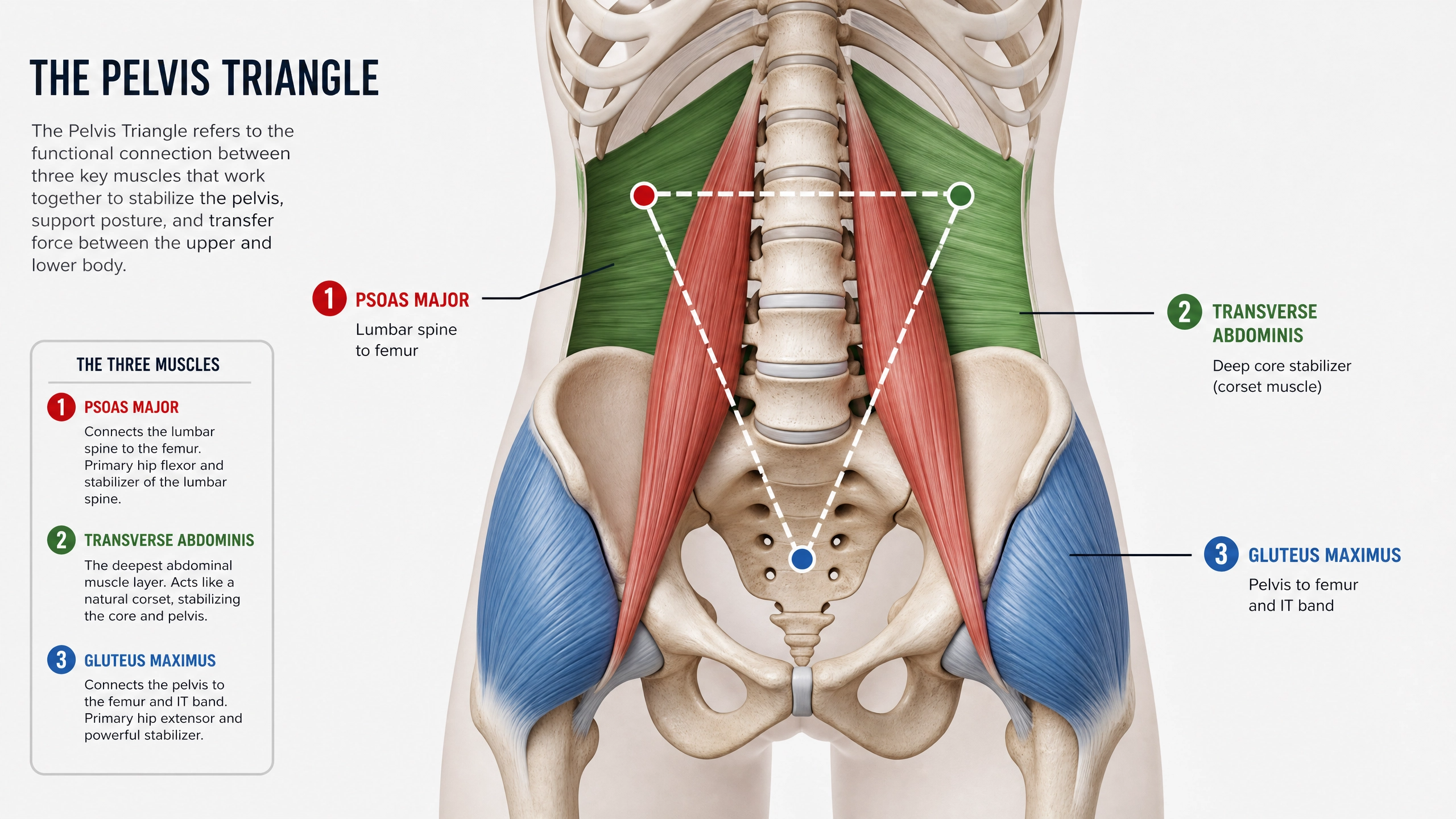
The answer might lie in a crucial, often overlooked, balance within your pelvis, YES.. PELVIS, a bone with a powerful trio of muscles we at Katasi Physiotherapy in Nairobi call the Pelvis Triangle.
In your pelvis, there is a delicate balance between three muscles that profoundly influences the state of your back, the appearance of your belly, and the quality of your daily movement.
When this balance is harmonious, everything functions smoothly, often without you even noticing.
However, when this equilibrium breaks.. and it almost always breaks in a predictable way, you inevitably pay the consequences, both internally and externally.
Let’s introduce the three protagonists of this vital triangle, each with a specific and indispensable role.
Meet the Power Players: Gluteus, Psoas, and Transverse
The Gluteus: Your Body’s Powerhouse
- The first is the gluteus, often hailed as the most powerful muscle in the human body.
- Its primary job is to push the thigh backward, extending the hip.
- It’s the muscle that provides the crucial push when you walk, climb stairs, or simply stand up from a chair. It’s your primary engine for forward propulsion and hip extension.
The Psoas: The Hip Flexor and Pelvic Puller
- The second is the psoas, which performs the exact opposite action of the gluteus. It brings the thigh forward, flexing the hip, and has a tendency to pull the pelvis forward.
- Think of the gluteus and psoas as the two “opposite engines” of the hip: one opens, the other closes.
The Transverse Abdominis
- Your Internal Corset.
- The third is the transverse abdominis, the deep muscular belt that wraps around your torso with horizontal fibers.
- Unlike the other two, the transverse doesn’t pull the pelvis in any specific direction; its role is to stabilize it.
- It holds the pelvis steady while the gluteus and psoas pull in opposite directions. Simultaneously, it creates the internal pressure that supports your spinal column from the inside out.
When all three are in balance, your pelvis rests in a neutral position. Your back maintains its natural, healthy curve, your abdomen is contained and supported, and every movement feels fluid and effortless.
Why the ‘Pelvic Triangle’ Breaks
The trouble is that modern life is essentially a training program designed to overwork just one of these three muscles: the psoas.
Hours spent sitting on the couch, driving in the car, or hunched over a desk cause the psoas to shorten. Gradually, it becomes increasingly dominant, while the other two muscles slowly “switch off.”
This is what happens;
The Gluteus Shuts Down
- It’s never called upon to work. Hours spent with the gluteus crushed and inactive lead the brain to stop “remembering” to activate it effectively.
The Transverse Turns Off
- Why?! Because nothing in a sedentary day stimulates it. A sedentary lifestyle never asks it to contract and stabilize.
At this point, the psoas wins the tug-of-war without any opposition, and the pelvis loses its balance.
The Domino Effect: When the Psoas Wins
Let’s examine what happens when this balance is lost. The shortened psoas pulls the pelvis forward.
The “switched off” gluteus cannot counter this pull, and the weak transverse fails to stabilize the structure.
The pelvis tilts forward, much like a tipping bowl. And you feel the consequences everywhere that include;
The toll on your back
- The lumbar curve becomes exaggerated, and the spinal discs are compressed. That stiffness you feel after sitting for a while and then standing up is often exactly this: the shortened psoas keeping your spine tense, and the gluteus failing to “open” your hip when you stand.
- It’s akin to a car running solely on the starter motor because the main engine is off. Technically, it moves, but everything is under immense stress.
The strain on your pelvic floor
- The abdominal contents slide forward into the tilted “bowl” of the pelvis, and the weak transverse abdominis cannot hold them back.
- The lower part of the abdomen protrudes, especially below the belly button. No diet will change this because it’s not fat; it’s the container itself that has tilted and is no longer containing its contents effectively.
The change in your walk
- The gluteus, which should be the primary engine of every step, is essentially turned off.
- Consequently, the lumbar spine compensates for every step you take. You walk, but you are walking with your back instead of with your glutes, leading to fatigue and pain.
Why “Quick Fixes” Fail and How Katasi Physiotherapy Can Help
This interconnectedness is precisely why “separate” or isolated solutions rarely work.
- Do you stretch the psoas but fail to reactivate the gluteus? You remove tension from one side without providing strength to the other. The tug-of-war remains unbalanced; you just have a slightly longer rope.
- Do you do endless tummy crunches? The pelvis remains tilted, and the deep transverse abdominis is largely untouched.
- Do you squat for glutes? If the psoas continues to dominate, the gluteus won’t activate properly, even during a squat.
The cycle only breaks when you address the balance as a whole: you must relax the psoas, reactivate the gluteus, and strengthen the transverse abdominis simultaneously.
When the pelvis returns to a neutral position, the symptoms improve together. The lumbar curve normalizes, and the back is relieved of constant tension.
The profile of the belly changes because the pelvis straightens, and the internal “belt” holds firm again. The gluteus regains its position and tone to work effectively, and your gait transforms.
The pelvic floor stops being overloaded because the transverse resumes its role in distributing pressure.
These are not four separate improvements; it is the restoration of a single, vital balance, and your entire body benefits.
Final Advice
If you’re ready to address the root cause of your back pain, posture issues, or movement difficulties, Call Katasi Physiotherapy in Nairobi is here to help.
Author
Moses Katasi - Orthopedic Physiotherapist Contact
BSc, Dip, Post-graduate Diploma in Orthopedic Physiotherapy - AMREF International University, Certified Clinical Physiotherapy Instructor (CPTI) Kenya, Optimal Dry Needling Specialist (ODNS) at International Academy of Orthopedic Medicine(IAOM) - USA.
Disclaimer:
This blog post is for informational purposes only and does not constitute medical advice. Always consult with a qualified orthopedic physiotherapist or healthcare professional for diagnosis and treatment of any medical condition.