
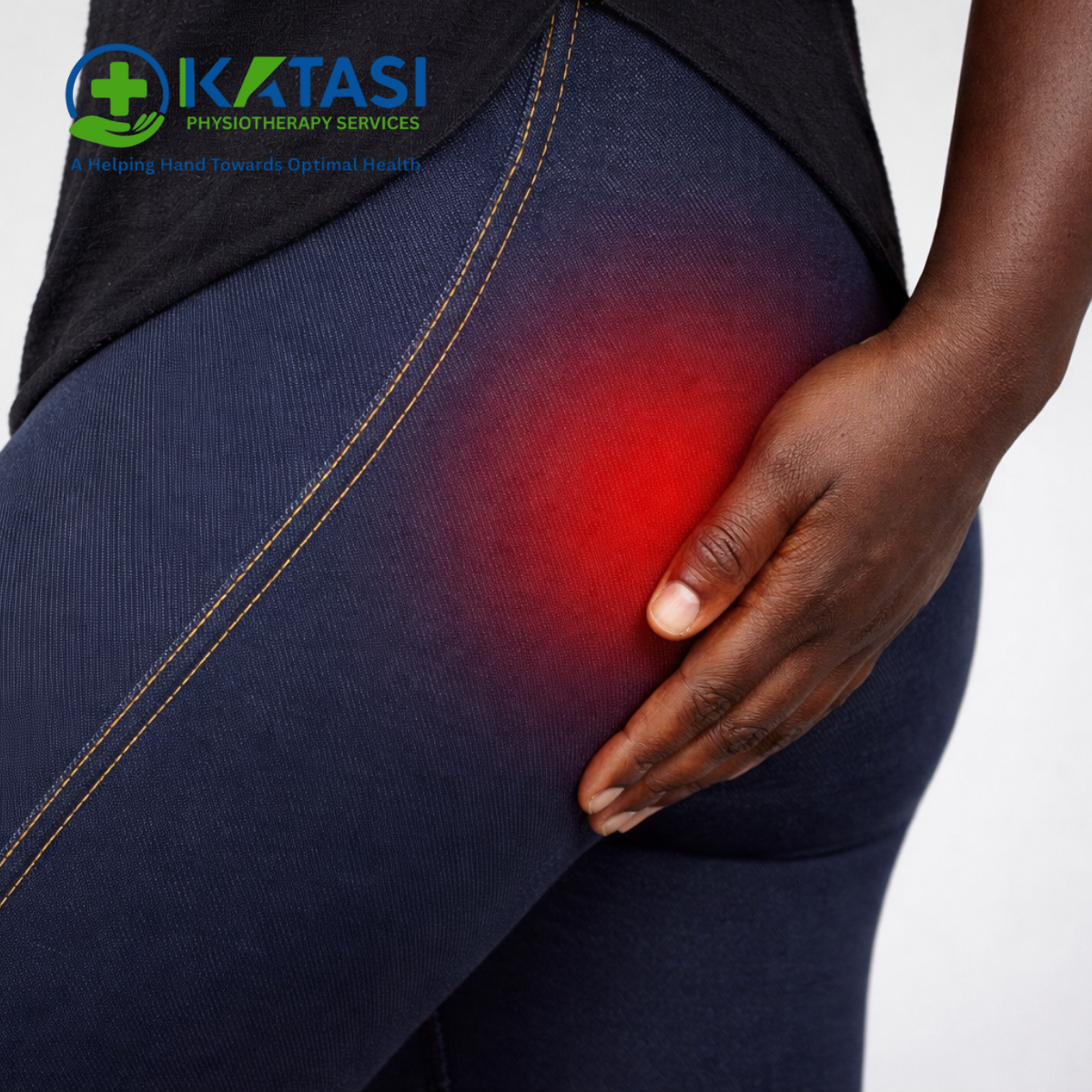
Deep Buttock Pain Treatment in Nairobi | Gluteal Pain Syndrome Relief
Cause of Hip and Leg Pain Most People Miss
Have you ever felt a deep, nagging pain in your buttock that just won’t go away.
-Maybe it gets worse when sitting.
-Maybe it travels down your leg.
-Maybe you’ve been told it’s “just sciatica” but treatment isn’t working.
-You’re not alone.
Deep buttock pain, often referred to as Gluteal Pain Syndrome (or Deep Gluteal Syndrome), is one of the most misunderstood causes of hip and leg pain. Many people go months, even years, without the right diagnosis.
As an orthopedic physiotherapist let me help you understand this condition..
What Exactly Is Deep Buttock Pain?
Deep buttock pain comes from irritation of structures deep inside the hip, especially around the sciatic nerve.
Instead of coming from the spine, the pain originates from:
- Tight deep muscles.
- Nerve compression.
- Movement dysfunction associated with muscle weakness and compensation during movement.
This is why many people are misdiagnosed with “sciatica.” Which is not always the case!
Why Is It Misdiagnosed
In many scenarios buttock pain is originally associated with ‘nerve-related’ pain and thought to be as a result of;
-“It’s a slipped disc”.
-“It’s sciatica”.
-“It’s just muscle strain”.
Not all leg pain comes from the spine. In many cases, the problem is within the buttock itself, where the sciatic nerve gets irritated or trapped which can be as a result of one or two weak or tight muscles in the glutes (buttock).
And its “the reason why?!”
- Scans may come back “normal”.
- Painkillers don’t fully help.
- Symptoms keep returning
- Especially deep muscles like the piriformis
Causes of Deep Buttock Pain
From an orthopedic physiotherapist perspective, these are the main contributors of deep buttock pain:
1. Muscle Tightness and Overload
Especially deep muscles like the piriformis which is common in people who sit a lot or suddenly increase activity.
2. Nerve Compression
The sciatic nerve can get pinched within the buttock which mimics “true sciatica” pain.
3. Poor Movement Patterns
As a result of weak glutes (buttock muscles) other muscles overwork leading to irritation over time.
4. Prolonged Sitting
This is one of the biggest triggers and as a result there is compression on structures and reduces circulation this is not to say, NO to sitting it’s only symptomatic in this case.
5. Previous Injury or Strain
Old injuries can create scar tissue and stiffness.
Common Symptoms of Deep Buttock Pain
- Deep aching pain in one buttock.
- Pain when sitting (especially after 20–30 minutes).
- Pain spreading to the back of the thigh.
- Tingling or numbness down the leg.
- Pain when walking or taking long strides.
- Limping in more severe cases.
- Night pain that disrupts sleep.
Most people have symptoms on one side, but it can affect both.
Treatment
The good news is that this condition responds very well to the right physiotherapy through;
1. Targeted Exercises
-Release tight deep muscles.
-Strengthen weak glutes.
-Improve hip control.
2. Nerve Exercises
-Helps the nerve glide freely again.
-Reduces irritation and symptoms.
3. Manual Therapy
-Hands-on treatment to relieve tension.
-Improves circulation and mobility.
4. Dry Needling
-Use of dry needles to release tight muscle bands that are taut which are active or latent trigger points.
5. Posture and sitting Correction
-Small changes results to big relief.
-Especially for office worker.
6. Activity Modification
-Adjusting walking, gym, or daily habits.
Final Advice
If you’ve been dealing with:
-“Stubborn sciatica”.
-Unexplained buttock pain.
-Pain that worsens when sitting.
There’s a high chance the issue is coming from the deep gluteal region and not your spine.
And the right physiotherapy approach, like ours can completely change your recovery.
Author
Moses Katasi - Orthopedic Physiotherapist. Book an appointment
BSc, Dip, Post-graduate Diploma in Orthopedic Physiotherapy - AMREF International University, Certified Clinical Physiotherapy Instructor (CPTI) Kenya, Optimal Dry Needling Specialist (ODNS) at International Academy of Orthopedic Medicine(IAOM) - USA.